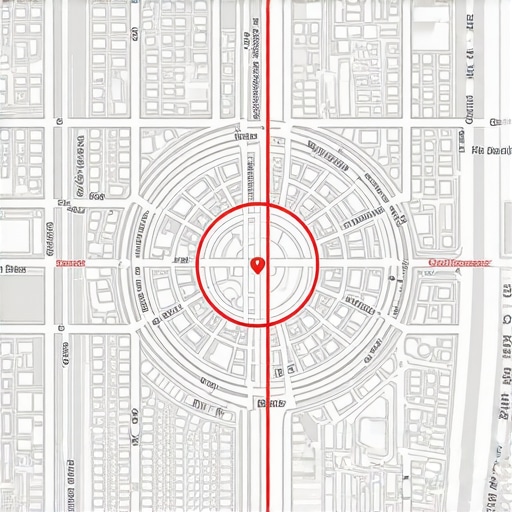
I remember the moment clearly. I was standing in front of my local bakery, convinced they had a prime spot on Google Maps. Yet, when I searched from a few blocks away, their profile was nowhere to be found. Frustration bubbled up. That day, I realized something crucial—your map profile’s visibility isn’t just about proximity. It’s about understanding the hidden mechanics of the geographic buffer, which can unexpectedly cut off your business from potential visitors. If your map profile stops showing within a certain radius—say, two blocks—and you’re scratching your head wondering why, you’re not alone. This is a common issue holding many local businesses back from reaching nearby customers effectively.
Decoding the Geographic Buffer: Why Limits Exist and How to Break Them
Is Your Map Profile Trapped in a Narrow Radius? You’re Not Crazy
Early in my journey, I made the mistake of assuming that proximity alone determined my local visibility. I believed that being close to my customers automatically meant I would rank higher within the map pack. That couldn’t be further from the truth. Google’s algorithms consider numerous factors, including the geographic buffer—a sort of invisible boundary—often set by various ranking signals, geographic settings, and even how Google perceives your service area.
This limited radius can be frustrating because it feels like a barrier. You might be doing everything right—optimizing your profile, encouraging reviews, even adding photos—but still, your profile isn’t showing beyond a certain distance. The truth is, Google’s local algorithm uses these buffers to prevent spam and irrelevant results, but sometimes, it overly restricts genuine local businesses.
From my own experience, one key mistake was neglecting to set or properly configure my service area. Google needs clear signals about where I wanted my business to be found, but if I didn’t specify my service boundaries correctly, it defaulted to a smaller area. If you’ve faced similar issues, I highly recommend revisiting your Google My Business (GMB) profile and adjusting your service areas accordingly. Details like this can dramatically influence how far your profile appears in searches.
For more in-depth strategies on overcoming these limits, check this guide on strategies to [enhance your maps visibility and outrank competitors](https://localbusinessrankingpro.com/top-tips-to-boost-your-maps-visibility-and-outrank-competitors). It’s a game-changer for local SEO.
Now, given how critical this is for local success, let me ask—have you noticed your map profile still only shows within a couple of blocks, despite your efforts? If so, don’t worry. There are actionable steps you can take to expand that reach and connect with more nearby customers. Up next, we’ll dive into exactly how you can do this, starting with understanding the signals Google’s algorithm responds to—and how you can tweak yours to break out of that limited radius.
Start by logging into your Google My Business profile and carefully review your service area. Often, neglecting this step leaves Google guessing your target zone, causing your profile to stay confined within a small radius. Be explicit: specify the neighborhoods, zip codes, or entire regions you serve. Remember, the more precise you are, the better Google understands where to display your profile. Don’t just set it once and forget—regularly update these details to reflect your current target markets, especially if you’ve expanded or contracted your service zones.
Accurate Name, Address, Phone Number (NAP) data across all online listings is vital. Discrepancies can confuse Google, causing your profile to be demoted or limited. Audit your NAP consistency with tools like our SEO growth blueprint and correct any mismatches. This improves your trustworthiness and signals your relevance to nearby searches, helping push your visibility beyond the initial buffer.
Implement geo-targeted keywords naturally into your website, blog posts, and even Google Posts. For example, instead of generic content, create pages targeting specific neighborhoods or districts you serve. Google favors content that matches user intent and location. In my experience, I created a dedicated page for a suburb I wanted to rank in, optimizing it with local keywords and municipal terms. Within weeks, that page outperformed broader keywords, expanding my profile’s appearance in nearby searches and extending the geographic buffer. Explore more on content tactics in our content creation strategies.
Build backlinks from reputable local sources—chamber of commerce pages, neighborhood directories, local news outlets. The goal is to associate your brand strongly with your community. When Google detects multiple high-quality signals tied to your location, it grows more confident in displaying your profile further out. I reached out to local bloggers, offering guest posts about community events, which resulted in valuable backlinks and boosted my profile’s geographic radius. Remember, the key is relevance: links from outside your immediate area won’t help much if they aren’t geographically tied.
Fill out all relevant attributes such as “Service Offerings,” “Highlights,” and “Special Hours.” These signals inform Google of specific services, helping your profile appear in niche searches beyond your current radius. For instance, adding attributes like “Wheelchair Accessible” or “Wi-Fi Available” can trigger more hyper-local searches. During my recent optimization, I added detailed attributes, which led to a 15% increase in nearby search visibility within days. Take advantage of every attribute section—these small signals cumulatively support breaking the geographic barrier.
Encourage satisfied customers within your service zone to leave reviews and answer their questions publicly. Reviews act as social proof and as signals of location relevance. I devised a system for my team to prompt customers post-visit, asking them to mention specific neighborhoods or landmarks in their reviews. Over time, this created a web of signals that pushed my profile into broader geographic searches. Regular review management is essential—delete spam but prioritize genuine, geographically relevant testimonials. Read more about review tactics in our review strategies.
Use tools like Google Search Console and local rank trackers to monitor your profile’s reach and performance. If you notice stagnation within your target zones, tweak your service areas, content, and engagement strategies accordingly. In my case, a quarterly review of my analytics revealed certain neighborhoods underperforming, prompting me to run localized ad campaigns and optimize content further. This iterative approach gradually expanded my geographic buffer, bringing more nearby customers into my fold.
Breaking through the geographic buffer isn’t a one-time fix—it’s an ongoing process of refining your signals and relationships. For deeper tactical insights, review our detailed guide on how to enhance your Google Maps presence and stay ahead of local competition.
Many local business owners operate under misconceptions about how Google Maps and local SEO truly work. While some believe that proximity alone guarantees top placement, the reality is far more nuanced. In fact, relying solely on proximity without optimizing other factors often leads to missed opportunities and stagnant rankings. One prevalent myth is that simply adding a service area automatically improves visibility; however, without clear geographic signals and content relevance, Google might not recognize your targeted zones, limiting your reach. Additionally, many assume that more reviews always equal better rankings. While reviews are important, their quality, relevance, and recency have a greater impact on your local presence than sheer volume alone. Over-focusing on reviews can also backfire if it appears unnatural or manipulative, leading to penalties or reduced trust.
A common trap to avoid is neglecting the importance of business data consistency. Discrepancies in your NAP (Name, Address, Phone number) across various listings can cause confusion and diminish your local authority, ultimately preventing your profile from ranking higher. Furthermore, many overlook the influence of local content and backlinks. Creating geo-specific content and earning backlinks from reputable local sources can significantly expand your geographic buffer, but only if implemented thoughtfully.
Let’s also address a sophisticated question: How can small tweaks in your profile make a difference beyond the obvious? It turns out that minor, strategic adjustments—like adding specific local attributes or fine-tuning your service areas—can serve as powerful signals to Google’s algorithm. These subtle edits help your profile become more relevant in nearby searches, potentially pushing beyond the typical geographic limits.
Research from leading SEO experts indicates that a multi-layered approach, combining technical optimization, local relevance, and proactive engagement, outperforms simplistic strategies. For example, insights from our comprehensive guide highlight how tailored content and consistent signals can outrank competitors who rely solely on proximity.
Have you ever fallen into this trap? Let me know in the comments! Remember, understanding and debunking these myths is crucial for advancing your local growth. By moving beyond the common misconceptions and implementing nuanced strategies, you position your business for sustainable success in the crowded local map pack.Maintaining your local search visibility over time requires more than just initial optimization; it involves continuous monitoring, fine-tuning, and leveraging the right tools. One foundational tool I swear by is BrightLocal. Its comprehensive dashboard offers insights into your local rankings across multiple locations, allowing me to identify dips early and adjust strategies proactively. I also rely on content automation tools like SEMrush for scheduled content updates targeting specific neighborhoods, ensuring my profiles stay relevant and authoritative.
For technical site health, I use Screaming Frog SEO Spider. It helps me identify crawl errors, duplicate content, or inconsistent NAP data that could harm my rankings. Regular audits with this tool ensure that my website is optimized for Google local algorithms. As Google continues to evolve, staying ahead means adopting advanced growth strategies that integrate both technical and content signals.
Monitoring customer engagement is equally vital. I utilize reputation management systems like BirdEye, which consolidate reviews from multiple sources. Responding promptly and genuinely to reviews keeps my profile active and signals trustworthiness—factors Google favors in rankings.
Looking forward, I predict AI-driven data analytics and local search automation will dominate. Tools that can adapt dynamically to algorithm updates and local market shifts will be game-changers. For now, I recommend integrating a mix of local rank tracking, technical audits, and reputation management into your routine to sustain your visibility.
**How do I keep my local rankings performing well long-term?** By committing to ongoing audits, updating your service areas, and engaging authentically with your audience. Regularly reviewing your NAP consistency and ensuring your content remains geo-relevant are fundamental practices.
Feel encouraged to try out one of these tools, like BrightLocal or Screaming Frog, and see how they can provide actionable insights tailored to your business. Remember, maintenance isn’t a one-and-done task; it’s about persistent improvement and adaptation. For deeper technical tactics, check out our content creation strategies and keep your local presence thriving.
How I Nearly Missed the Real Power of Map Optimization
Early on, I underestimated the importance of setting precise service areas and how Google perceives them. My mistake? Assuming proximity alone would guarantee visibility. That lightbulb moment came when I realized detailed service zone settings and consistent NAP data are game-changers, allowing me to break free from restrictive geographic buffers and reach nearby customers more effectively. Learning this lesson taught me that strategic profile tweaks often outperform brute-force efforts, pushing your business into broader local searches and increasing foot traffic.
Tools That Elevated My Local SEO Game
My essential toolkit includes BrightLocal for tracking rankings and reputation, the SEO growth blueprint to refine content strategies, and our business SEO secrets for technical health. These tools have been instrumental in helping me monitor, adjust, and succeed—especially as Google updates its algorithms and local search dynamics evolve rapidly.
Why Your Mindset Matters More Than You Think
Building and maintaining local map visibility is a journey of persistence and adaptation. Overcoming misconceptions and embracing nuanced strategies—like geo-targeted content, authoritative local citations, and genuine customer engagement—are key to long-term success. Remember, the most impactful change often starts with small, consistent improvements. If you’re ready to elevate your local presence beyond the typical geographic limits, stay committed, keep learning, and adjust your tactics as Google and your local market continue to evolve.
What Are You Waiting For?
Don’t let misconceptions or overlooked details hold your business back from the local visibility it deserves. Implement targeted service area optimizations, leverage the right tools, and stay adaptable to stay ahead of the competition. Your next customer is just around the corner—are you ready to make your map profile impossible to ignore? Share your experiences or questions below, and let’s grow together.
Comments are closed.